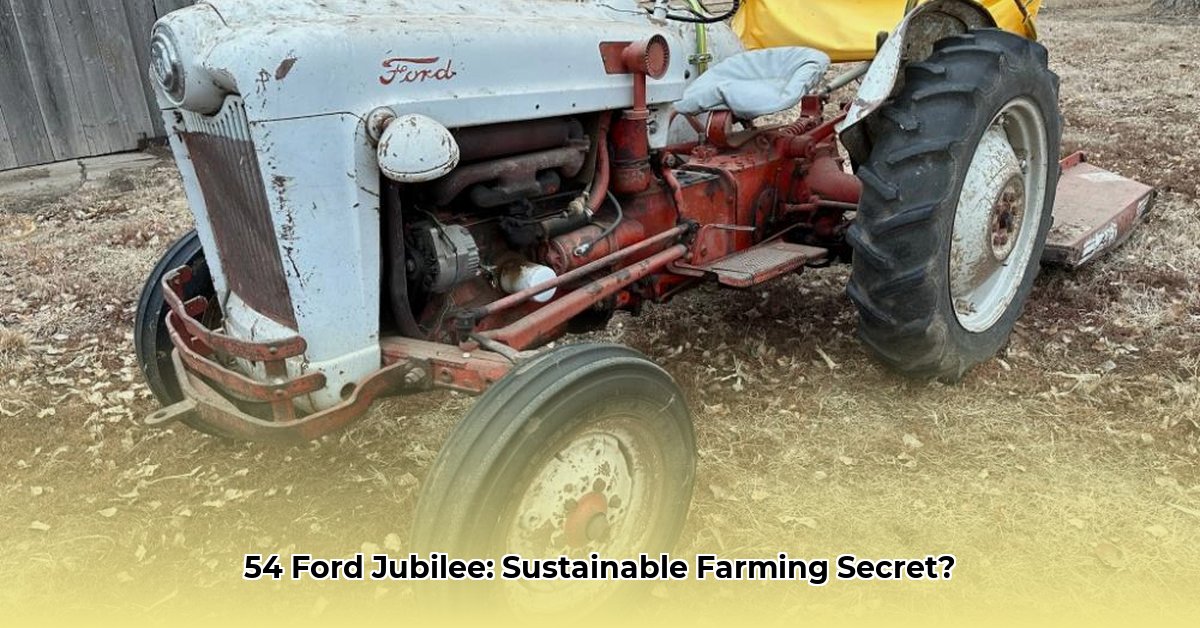
54 Ford Jubilee Tractor: A Retrospective on Sustainability
The Ford 54 Jubilee tractor, a product of a simpler era in farming, offers a unique lens through which to examine the evolution of sustainable agricultural practices. This article explores its impact, weighing its historical context against modern sustainability metrics. Was the 54 Jubilee a friend or foe of the environment? Let's delve into its legacy. For more on Ford tractors, see this helpful resource.
The 54 Ford Jubilee: A Mechanical Portrait
Unlike its modern, high-powered counterparts, the 54 Jubilee possessed a modest engine—a dependable workhorse, not a powerhouse. Its simplicity, however, was a key strength. Easy repairs reduced downtime and minimized waste from frequent part replacements, contributing to a surprisingly eco-friendly footprint for its time. The incorporation of a three-point hitch system, innovative for its era, further enhanced efficiency. This ease of repair is a concept highly relevant to today's circular economy movement.
Sustainability Scorecard: A Balanced View
While the 54 Jubilee offered versatility and maneuverability, its fuel efficiency pales in comparison to contemporary tractors. High fuel consumption was a significant drawback from a modern sustainability perspective, reflecting the priorities of its time. This comparison starkly illustrates the progress made in fuel economy and environmental consciousness in tractor design. Moreover, the tractor's reliance on manual labor, while potentially fostering a stronger farmer-land connection, contrasts sharply with the automation driving many modern sustainable farming initiatives.
Did this human-centric approach contribute to a unique form of sustainability? This is a question worthy of further research and discussion.
Stakeholder Impacts: A Multifaceted Perspective
The 54 Jubilee’s influence wasn't limited to the farm. Its impact rippled across various stakeholder groups:
| Stakeholder Group | Short-Term Impacts | Long-Term Impacts |
|---|---|---|
| Small-Scale Farmers | Reduced labor costs, increased efficiency | Greater farming independence, access to diverse crops |
| Local Mechanics | Increased demand for repair services | Development of specialized vintage tractor repair skills |
| The Environment | Mixed impact; increased efficiency offset by fuel use | Potentially reduced environmental footprint from longevity & repairability |
| Collectors | Created a market for vintage tractors | Preservation of agricultural history, unique hobby creation |
Circular Economy Principles: A Lasting Legacy?
The 54 Jubilee's repairability aligns directly with the principles of the circular economy, a stark contrast to the often disposable nature of modern farm equipment. Extending equipment lifespan translates to reduced manufacturing, resource consumption, and waste generation. Its robust design and easily-sourced parts serve as a powerful example of resource efficiency. This is a compelling argument for the reassessment of the entire agricultural machine lifecycle.
Lessons from the Past: Charting a Sustainable Future
While not a paragon of sustainable agriculture by today's standards, the Ford 54 Jubilee provides crucial historical context. It reminds us to consider the full lifecycle impact of agricultural technology, from production to disposal, and to examine the tradeoffs between efficiency, environmental impact, and resource utilization–a conversation critically important for the future of sustainable food production. This is further supported by the ongoing research into sustainable farming practices, constantly evolving our understanding of optimizing efficiency and environmental impact.
How can we effectively combine the strengths of older, durable machines with the advancements of modern, fuel-efficient technology? This is the key question driving the pursuit of a more environmentally responsible agricultural sector.
Assessing the Long-Term Environmental Impact of Vintage Farm Equipment
Key Takeaways:
- A holistic approach is crucial when evaluating the environmental footprint of vintage tractors.
- Life-cycle considerations extend beyond initial production to encompass fuel consumption, emissions, material durability, repairability, and end-of-life management.
- Direct comparison to modern alternatives demands a thorough lifecycle assessment, accounting for factors like technological advancements and scale of operation.
- The socio-economic impact, including community repair initiatives and knowledge sharing, should be included in any comprehensive assessment.
- Data limitations require creative research methods such as oral histories and archival research.
The 1954 Ford Jubilee: A Case Study
The 1954 Ford Jubilee's environmental impact requires careful examination. While not designed with modern sustainability in mind, its longevity and repairability could potentially offset its higher fuel consumption and emissions. This assessment is further complicated by the scarcity of precise operational data for this vintage model.
Methodology for Assessing Vintage Tractor Impact
- Data Gathering: Compile historical data from original documentation, owner manuals, and relevant historical agricultural societies or archives.
- Comparative Analysis: Compare fuel consumption and estimated emissions (using proxy data where necessary) with modern equivalents, carefully considering variations in horsepower and operational conditions.
- Durability Assessment: Evaluate the tractor’s inherent durability considering its design and the availability of repair parts and related knowledge. Explore repair manuals and online communities dedicated to vintage tractor restoration.
- Lifecycle Assessment: Account for the environmental impact of manufacturing, operation, and end-of-life management, acknowledging data limitations.
- Social Impact Assessment: Consider the contributions of community repair networks, the preservation of agricultural history and the transmission of repair skills.
[Note: This assessment acknowledges the challenges of obtaining precise historical data and encourages further research in this area.]